
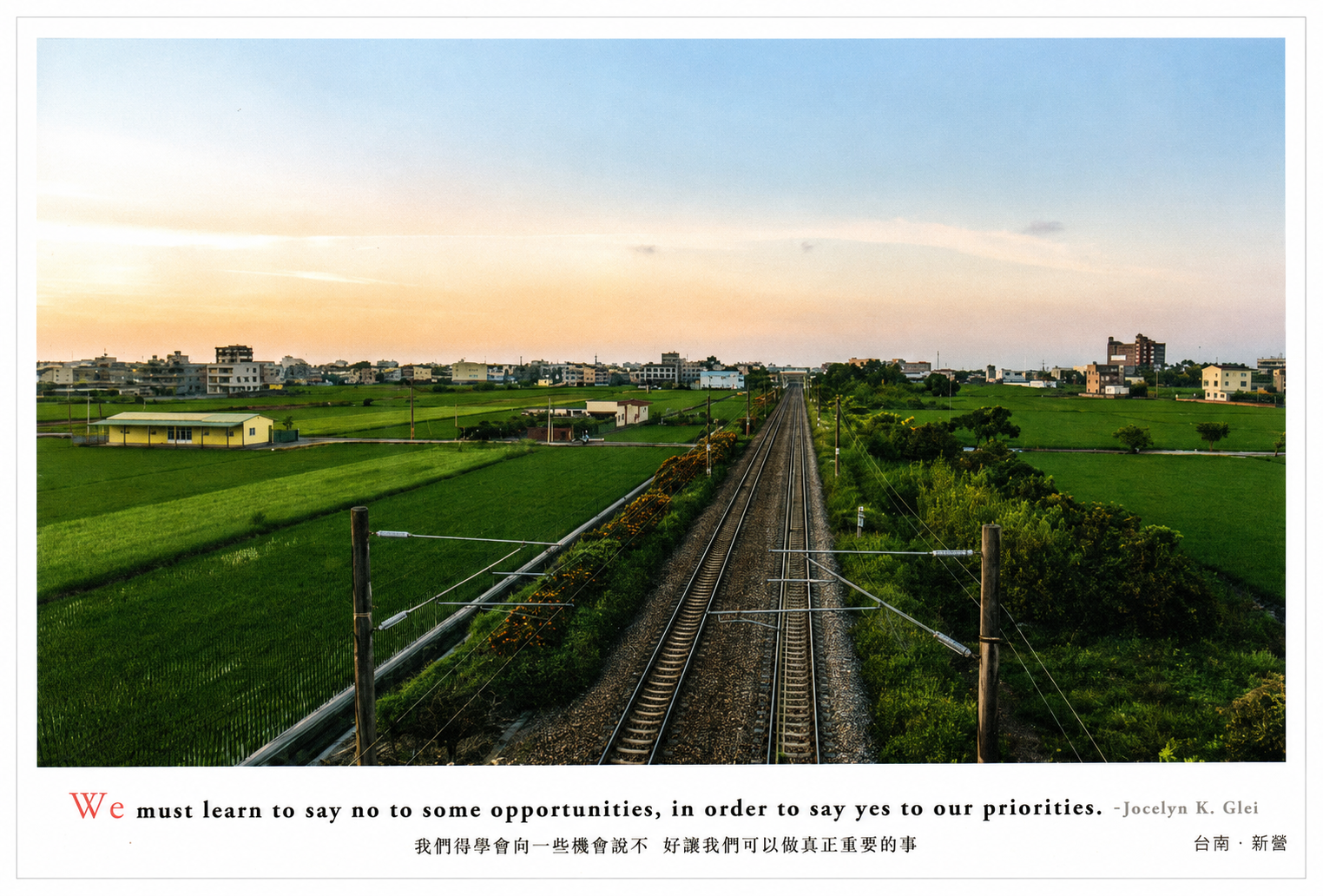







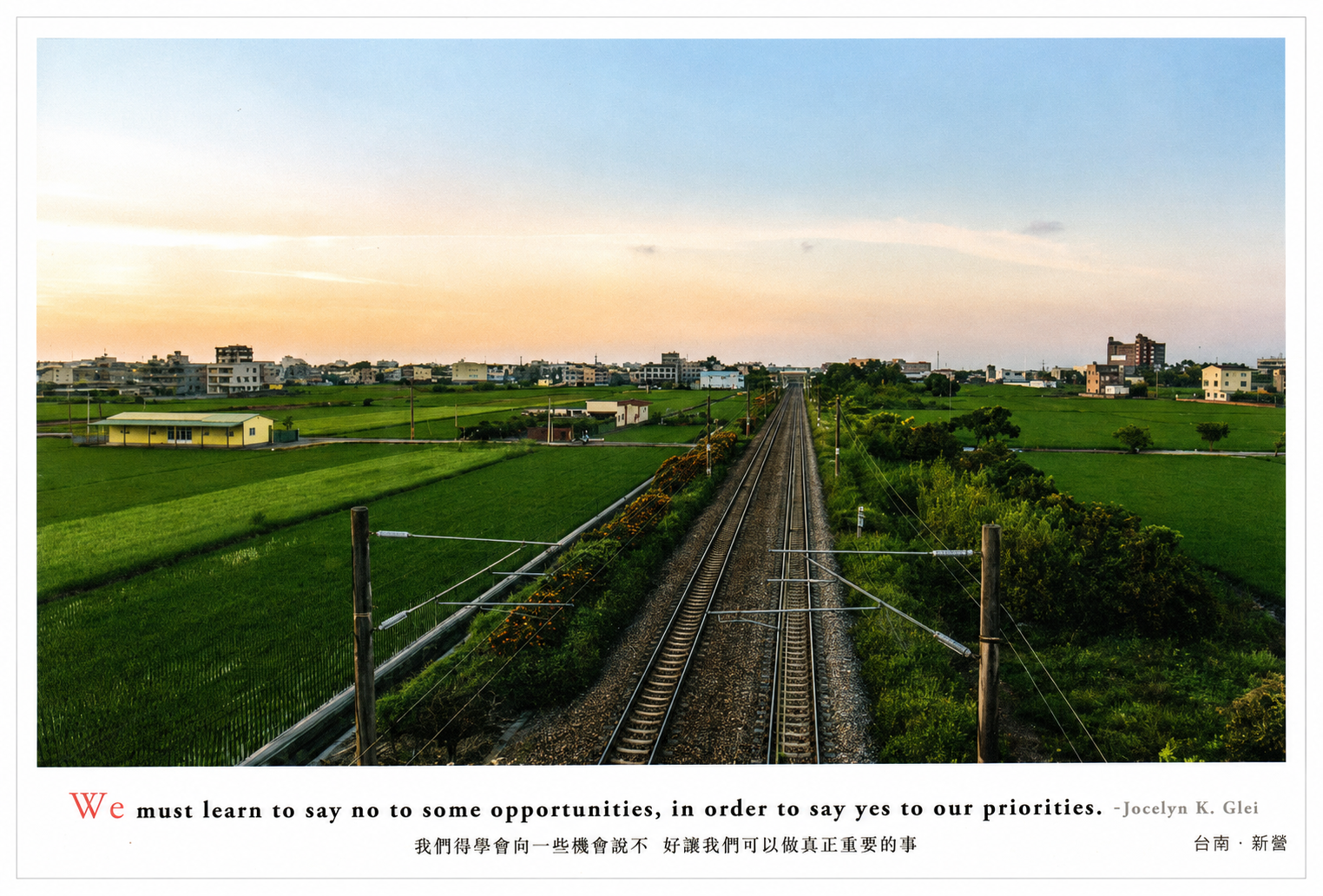
A postcard showing a railway line running through green fields towards low-rise buildings beneath a pale blue and orange sky.
Below the photograph is the quote: “We must learn to say no to some opportunities, in order to say yes to our priorities.” — Jocelyn K. Glei.
A Chinese translation appears underneath, alongside the location Xinying, Tainan
This strange title comes from something I have been pondering about STAF’s work.
Infrastructure is easy to overlook when it is doing its job. Arts Council England’s Excellence, for everybody, everywhere. Strategic Framework 2026 places excellence at the centre of its services and investment, alongside ambitions for inclusion and reach. It prompted me to return to a question I have carried for some time: what does excellence look like in the less visible work that makes creative practice possible?
This made me think of how I met Sarah, who lives in the flat below ours.
A few years ago, on Boxing Day evening, there was a knock at our door. Sarah had only recently moved in, and we had never met.
This was, unfortunately, our introduction.
Water was leaking from our kitchen into hers. By the time we went downstairs, she had something resembling a waterfall above her cooker.
Poor Sarah.
That was how we discovered the true condition of our water pipes. One had been connected at a peculiar angle, tilted upwards and held in place with a piece of string.
Somehow, it had worked… until it did not.
Water had been leaking quietly into Sarah’s newly fitted false ceiling. Gravity, at least, was working exactly as it should. The pipework was not.
I have often thought that organisational infrastructure and administration work in much the same way. When they function well, hardly anyone notices them. When they fail, everyone does.
We’ve all been there: a portal error that sends you on an archaeological dig; interrupted online banking that puts payments on hold; an online survey that keeps unfolding without telling you how much is left; or an automated message containing the wrong information, leaving you wondering if there has been a cybersecurity breach.
We rarely think about the infrastructure behind everyday tasks until it stops working. Then it becomes visible very quickly, and we all know how annoying that can be. More worryingly, a system may appear to work while already compromised.
The water may still be coming out of the tap. Underneath the sink, however, the pipework may be tied up with string.
What do we mean by infrastructure?
Infrastructure is often understood as something physical: roads, bridges, railways, water supplies or digital networks. But it also includes the processes, relationships, knowledge, standards and routines that allow people and organisations to function.
In the creative sector, that might mean funding systems, organisational processes and policies, professional networks, access support, shared knowledge, contracts, buildings, and the people who quietly keep these things working.
Susan Leigh Star, writing about the ethnography of infrastructure, observed that infrastructure tends to disappear into the background when it works. Her argument goes further: infrastructure is relational. The same system does not work in the same way for everyone.1
A funding process that feels straightforward to someone familiar with its language and unwritten rules may be bewildering to someone encountering it for the first time. A professional network that feels open to an established artist may be almost invisible to someone without the same contacts. A process designed to be efficient may create barriers for people whose circumstances were not considered.
Infrastructure is therefore not simply something that either works or does not. It works for particular people, in particular contexts, at particular times. Those contexts change, and infrastructure has to change with them. The Hodge Review offers a current example, calling for Arts Council England’s funding processes to be less bureaucratic and for a wider overhaul of its systems.
This is why we see the cultural sector as an ecology. Artists, organisations, funders, communities, relationships, resources and systems all affect one another. Just as one water pipe forms part of a much larger network, a problem in one part of the cultural sector may have causes and consequences elsewhere. More opportunities, for example, do not necessarily widen access if the processes around them remain inaccessible.
The need for this work is not abstract. In Greater Manchester, creative employment remains concentrated in the city centre, Salford Quays and a small number of other areas, while many parts of the city-region have little or none.2 Nationally, younger people from middle-class backgrounds remain far more likely than their working-class peers to enter creative occupations,3 while many theatre freelancers struggle to earn a sustainable living.4 Talent may be everywhere; the networks, resources and conditions that allow it to develop are not.
Creative infrastructure support therefore requires us to look not only at the individual parts, but at the relationships between them.
What makes infrastructure good?
Recently, I asked an old friend who works in infrastructure what makes infrastructure good.
He said it should be resilient, efficient, sustainable, adaptable to future needs, and designed with users and safety in mind.
The same applies to cultural and organisational infrastructure.
Resilient infrastructure should not collapse because one person leaves or one grant ends. Efficient infrastructure should reduce unnecessary friction. Sustainable infrastructure should not depend on exhaustion or unpaid labour. Adaptable infrastructure should respond as needs change. And user-centred infrastructure should begin with the people who rely on it
The important point is that functioning infrastructure is not necessarily good infrastructure.
A project may be delivered because someone worked late every night. An organisation may appear stable because one person carries all the knowledge. Visible success can conceal fragile infrastructure.
Just as our pipe continued carrying water while being held in place by string, a system can keep producing visible results while remaining fragile, exclusionary or unsafe.
The excellence of the outcome does not automatically prove the excellence of the infrastructure beneath it.
Where is the creativity in STAF’s work?
There may be no stage, launch or obvious finished product. Creativity at STAF shows up as problem-solving, connecting ideas, seeing patterns and finding practical ways forward. Good infrastructure cannot simply be put in place and left alone. It has to respond to people, context and changing needs.
We start with what artists and organisations already bring: knowledge, experience, relationships, values, ambitions and ways of working. We ask what is strong and working, what is under pressure, and what may be getting in the way.
Sometimes that means helping someone step back and focus limited time and energy on what matters most. Sometimes it means improving a process, making a connection, opening access to knowledge or creating room for reflection. Sometimes the main change needed is not within the person or organisation, but in the surrounding conditions.
The creativity lies in understanding what is happening, for whom, and what might need to change. The excellence lies not in arriving with a finished design, but in paying close enough attention to work out what infrastructure is actually needed.
From individual support to system change
That work cannot end with one person or organisation.
A single leaking pipe may need an immediate fix. But if the same fault keeps appearing, we need to examine the wider network.
The same is true in the cultural sector. A difficulty that appears personal may be organisational. An organisational problem may reflect a wider sector practice. A sector pattern may connect to deeper inequalities in society.
For STAF, system change begins with paying attention to what we learn through direct work. When same barriers, workarounds, or inequalities recur, they tell us something about the wider ecology. The individual leak gives us information about the condition of the network.
Our role is therefore not simply to help people fit into the system as it exists, but also to ask what might work better. That may mean sharing learning, influencing practice, bringing people into conversation, or testing different approaches. We cannot redesign the whole cultural sector alone. But we can connect individual experience with wider questions about how opportunity, knowledge and resources are distributed.
So, where is the excellence?
Perhaps the excellence in STAF’s work is not always in what can be seen.
It is in noticing what may have been overlooked; recognising the strengths already present in people, while also seeing the barriers around them; and understanding that infrastructure works differently for different people and must change as needs change.
It is in connecting immediate, practical support with learning about the wider system. And it is in bringing creativity to work that may look, from the outside, rather boring.
Good infrastructure should not require heroics simply to keep functioning. It should not rely on a piece of string, or on people quietly compensating for its weaknesses.
It should create the conditions in which more people can create, contribute and thrive.
That, to me, is where the excellence lies.
References:
1. Susan Leigh Star, ‘The Ethnography of Infrastructure’, American Behavioral Scientist, 43(3), 1999, pp. 377–391.
2. Bruce Tether, Creative Clusters and Sparse Spaces: Manchester’s Creative Industries and the Geographies of Deprivation and Prosperity, Creative Industries Policy and Evidence Centre, 2022.
3. Erica Holt-White et al., A Class Act: Social Mobility and the Creative Industries, Sutton Trust, 2024.
4. Freelancers Make Theatre Work and the University of Essex, The Big Freelancer Survey 2024: Freelancers at Breaking Point, 2024.
